
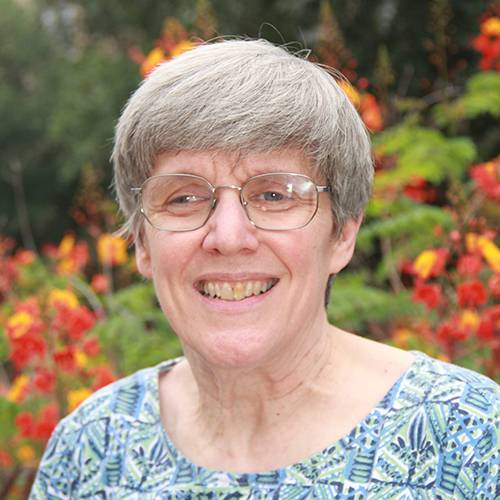
We had the opportunity to speak with the longest-tenured current librarian in University Libraries, and we’re honored to share her wisdom and experiences. Margaret Vaverek, who has worked at the library for over forty years, reflects on her journey, the changes she has witnessed, and the lasting impact of libraries on the university community.
Can you share a bit about your role at Alkek Library?
That’s an interesting question because, especially now with the growth of the university, no one really has just one role. I’m part of the Scholarly Resources Department, which is public-facing, faculty and students come to me with research questions and projects. Whether that’s a student writing a paper for a history class or faculty working on books and journal articles.
I’m also on the library instruction team, so I teach classes. I work on copyright education alongside Stephanie Towery and Tara Smith; we function as a team. I’ve also become something of the library’s institutional memory, so Special Collection & Archives sometimes comes to me with questions about our history.
I serve as the liaison to the College of Liberal Arts, meaning their faculty and students can come to me for research support as the library continues to grow and become more complex. I really enjoy wearing all these different hats.
How long have you worked in the library, and how has its evolution shaped your growth and vice versa?
I started in 1986. At that time, it was still a predominantly print world. There was no internet on campus. When I first walked into the reference office, located in JCK before Alkek was built, there were six desks and one Apple IIe computer for the entire department. If you wanted to type a letter (no email services yet), you used that machine.
Research was entirely print based. If you wanted a Time Magazine article, you had to use print indexes, then locate the physical issue, current copies on one floor and older ones on microfilm elsewhere.
It’s been fascinating to watch the shift to an electronic world. One of the first big changes was InfoTrac, which allowed patrons to find articles connected to topics, though the machine didn't indicate where (in the building) the materials were located- just let you know that we subscribed (or not) to the magazine/journal. When Alkek Library opened in 1990, technological change accelerated. I was hired as a government documents librarian and spent four years in that role. Interestingly, I recently led the project to dismantle much of that print collection as we transitioned to electronic access. We’re still a repository but now it’s largely digital.
What does a typical day look like?
One of the things I love most about this job is that there isn’t a typical day. I may have a general plan, prepping for classes, working on projects but then an email comes in from a faculty member or student who urgently needs help. That becomes the priority.
I enjoy that unpredictability. Ultimately, I work for the faculty and students at Texas State.
What’s one thing you wish every student could fully experience or take advantage of?
Without a doubt, individual consultations with librarians. We’re educated in information-seeking behavior. Anyone can find something but how do you know it’s the right, credible material? A librarian can guide you toward strong sources and help you understand how to evaluate them yourself.
I do a lot of research consultations, and so often students say, “I wish I had known about this service sooner.” Many don’t realize that we offer research support at a variety of levels from that first interaction with students at the main desk to in-depth research consults with librarians. These consults can completely change how students approach scholarly research. And if I don’t know something, I have a team of gifted colleagues who can help.
What exciting project are you currently working on?
I was recently interviewed for part one of a two-part podcast series called Lone Star Lore, which explores myth versus fact in Texas history.
We talked about the research process, how you move from question to evidence, how to locate primary and secondary sources, and how to determine what you can trust. I have degrees in history in addition to my library degree, and I realized early on that what I loved most about history was the research itself.
For me, it’s about the thrill of the hunt. Ask me a question, and I want to find an answer.
What’s your favorite part about being part of the Alkek Library team?
The library sits at the heart of campus life. Everything we do supports students, faculty, and staff. I’m proud to be part of a team whose daily work contributes directly to that mission.
How did your journey into libraries begin?
Interestingly, I didn’t spend a lot of time around libraries growing up. But once I started studying history in college and discovered how much I loved research, I realized I wanted to do that full-time. I didn’t want to focus on teaching or writing research, I wanted to investigate and uncover answers, and the library happened to be the place where I could do just that.
I was fortunate to have mentors who were passionate librarians and generous with their knowledge. Their enthusiasm inspired me. I also saw student workers go on to library school and return, which always struck me as meaningful. It showed that this work mattered.
What’s your “library superpower”?
Researching, almost to a fault. I genuinely want to know the answer, no matter what someone does with it.
If your job had a tagline, what would it be?
We help searchers become researchers.
Information is everywhere now but knowing what’s reliable and how to use it well is a skill. We help people build that skill.