


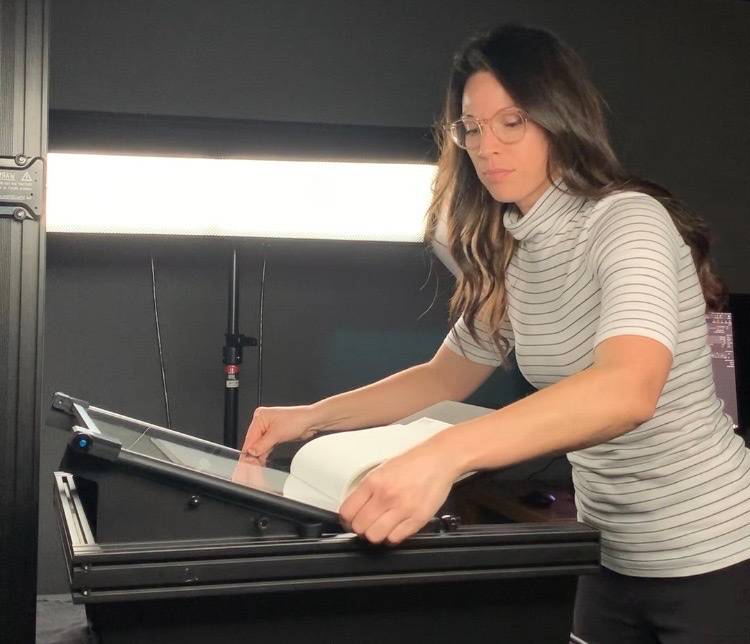
The Libraries’ Digitization Lab supports Texas State University’s teaching, learning, and research by digitizing collections for inclusion in TXST-supported public repositories (currently either the Institutional Repository or Digital Collections platform) and digital exhibits to make materials accessible to the TXST community and global researchers.
The lab also handles small private requests from faculty or researchers when they support academic needs at TXST. It also assists in preserving university or partner collections for long-term research use.
By digitizing and preserving materials, the lab enhances access to TXST’s collections, supports academic goals, and benefits the broader scholarly community.
Material Types Accomodated
The Digitization Lab is able to digitize a wide range of 2D materials and some types of audiovisual materials. Note that if materials are particularly oversized (i.e., over 24 x 32 inches), they may be better accommodated by a commercial vendor.
Materials that can be digitized by the lab include -
| Books | Photographs | Magazines |
| Documents | Postcards | VHS tapes |
| Posters | Still image film negatives and positives | Audio cassette tapes |
| Maps | 35mm slides | CD’s and DVD’s |
What to Expect if Requesting Digitization
To request digitization, you must either own the copyright for the materials or have permission from the copyright holder.
Consultation for digitization work is free. There is a flexible fee structure the Digitization Lab may apply depending on the University Libraries capacity and the nature of the project. For more information, contact the Head of Digitization and Preservation.
A preservation file and an access file are created for each digitized item with standard post-processing (e.g., cropping, rotating, trimming). However, the Lab does not re-house physical materials, provide conservation services, or restore digitized images. All digitization work follows national and international quality standards. General specifications are outlined below.
| Still Image | |
|---|---|
| Preservation File Format | Tiff (uncompressed) |
| Access File Format | JPEG or PDF |
| Resolution | 400 to 600 ppi (for paper-based materials) 1200 to 4000 ppi (for photographic film material) |
| Bit Depth | 8-bit to 16-bit |
| Color Space | Adobe 1988 Grey Gamma 2.2 (for black & white photographic negatives) |
| Scale | 100% (1:1) |
| Audio | |
|---|---|
| Preservation File Format | WAV |
| Access File Format | MP3 |
| Sample Rate | 96KHz |
| Bit Depth | 24-bit |
| Video | |
|---|---|
| Preservation File Format | MKV |
| Access File Format | MP4 |
| Audio | 48KHz, 16-bit |
| Resolution | Standard Definition (720 x 480) |
| DVD | |
|---|---|
| Preservation File Format | ISO |
| Access File Format | MP4 |